
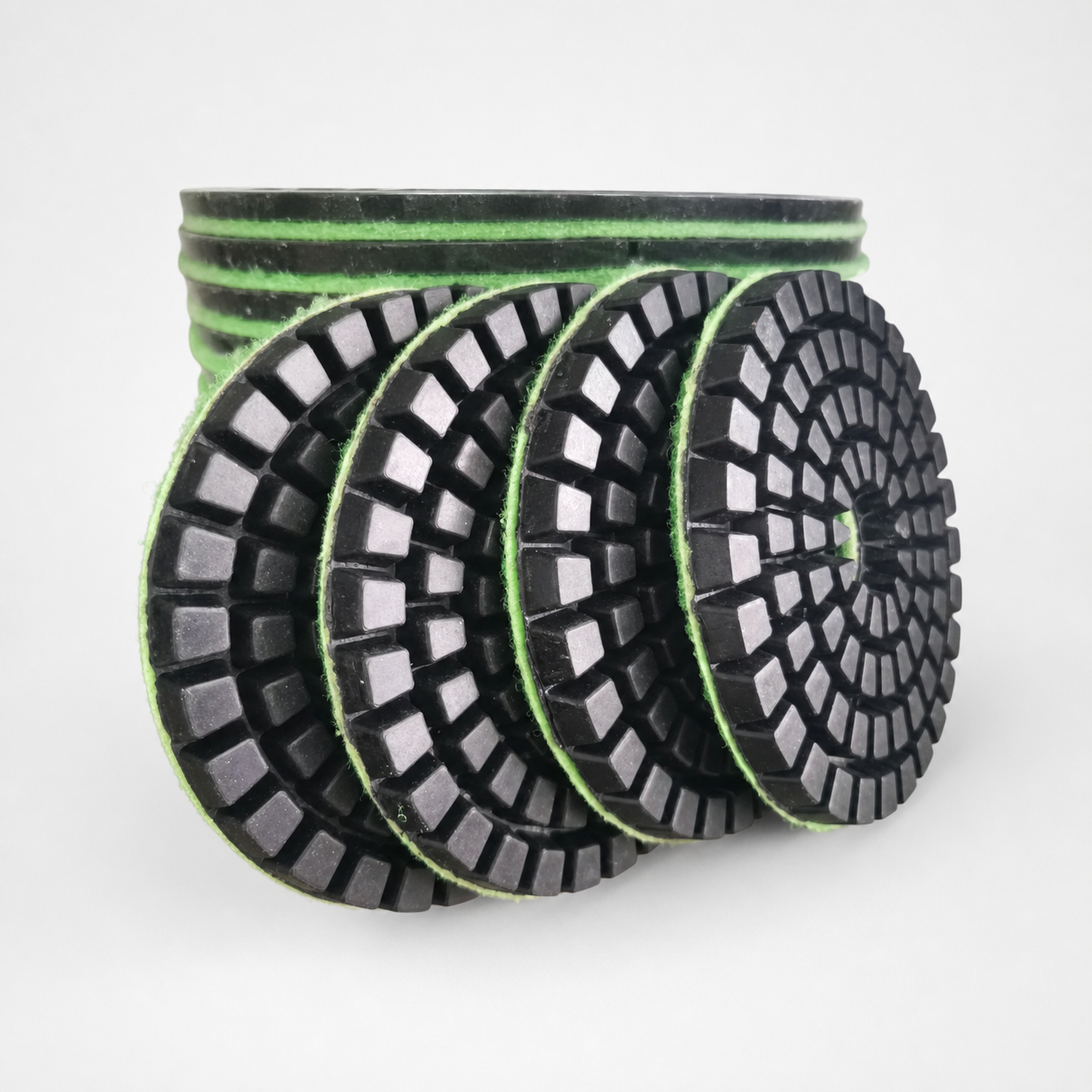
Grinder RPM and Plate Speed: Why Tool Diameter Changes Grinding Behavior
Quick answer: Two grinders running the same RPM do not cut at the same speed. The number that actually drives diamond wear, finish quality and production rate is the surface speed at the rim of the tool — and that value depends on tool diameter. A 3" plate and a 12" plate on the same machine head travel very different distances every second. Buyers who compare tools by RPM alone, without checking plate diameter and head configuration, often receive technically correct products that still underperform on their floor.

Why plate diameter changes the real cutting speed
Surface speed, sometimes called rim speed or linear speed, is the distance a point on the outer edge of the tool travels in one second. It is a product of rotation speed and the distance of that point from the centre of rotation. Because diameter is part of the calculation, a larger plate covers much more ground per revolution than a small one at identical RPM.
The practical formula is:
Surface speed (m/s) = π × diameter (m) × RPM ÷ 60
For imperial tooling, the equivalent relationship is surface speed in feet per minute = π × diameter in feet × RPM. Either way, the message is the same: diameter is not a minor correction, it is a direct multiplier.
This matters because diamond bond wear is driven by the abrasive's interaction with the floor — heat, pressure and the number of contact events per second. Doubling rim speed at a fixed load increases the work done per unit time, which changes everything downstream: how fast the bond releases diamond, how much heat reaches the segment, and how the surface profile develops.
How diameter and RPM interact on real machines
The table below shows indicative rim speeds for common concrete grinding plate sizes at typical machine RPM. Actual machine output depends on load, head configuration and tool holder geometry, so these values are planning references rather than guarantees.
| Plate diameter | Typical application | Relative rim speed at same RPM | What it means in practice |
|---|---|---|---|
| 3" (76 mm) | Edge work, small single-head grinders, detail areas | Baseline | Lower rim speed; pressure per segment is concentrated, finish develops slowly |
| 7" (180 mm) | Mid-size single-head machines, HTC-style holders | Roughly 2.3× baseline | Good balance of coverage and control for general preparation |
| 10" (250 mm) | Large single-head and multi-head machines | Roughly 3.3× baseline | High material removal; bond and grit must be matched to avoid glazing |
| 12" (300 mm) | Heavy production and large-area grinding | Roughly 4× baseline | Maximum coverage per pass; heat buildup needs controlled passes |
The relative column is what buyers should keep in mind. If a distributor switches from a 3" tool to a 10" tool on the same grinder without adjusting grit or bond, the floor may open faster than expected, and the operator may report that the tool has become "too aggressive" or that the surface is difficult to refine.
What happens when rim speed is too high
Excessive rim speed for the floor condition usually shows up as a cluster of symptoms rather than a single failure:
- Heat concentration. Resin pads and metal segments both generate heat faster than it can dissipate, particularly in dry operation.
- Premature bond wear. The bond erodes before the diamond is fully used, shortening tool life per square metre.
- Uncontrolled scratch pattern. Deep, irregular scratches appear where the operator expected a uniform preparation cut.
- Slurry and dust behaviour changes. Dry cutting can produce finer dust that loads filters faster; wet cutting may flash-dry at the tool contact point.
- Glazing on soft-bond tools. When heat builds, the bond can smear instead of wearing evenly.
In these cases, lowering RPM where the machine allows it, reducing head pressure, or moving to a harder bond or a finer grit often restores normal behaviour. A change in pass speed across the floor achieves a similar result without any tooling change.
What happens when rim speed is too low
The opposite problem is quieter but costs production time. When the tool runs slowly relative to its diameter, the diamond does not develop enough cutting energy per contact event:
- The tool polishes and burnishes instead of grinding, creating a slick, hard surface.
- Segments may glaze over because the bond does not wear enough to expose fresh diamond.
- Production rate drops, and operators compensate by pushing the machine harder, which overloads the head and the tool holder.
- Water or dust control may be adequate while actual material removal stalls.
A useful field check is to watch the slurry or dust colour and the scratch pattern after the first pass. Healthy grinding produces a consistent pattern that matches the grit on the plate. A polished, shiny track with little material removed is a signal that the tool is not working efficiently at the current combination of speed, pressure and floor hardness.

How machine type affects the usable speed range
Not every grinder exposes RPM as an adjustable parameter, and this shapes how tooling should be specified.
| Machine type | Speed control | Tooling implication |
|---|---|---|
| Single-head planetary, fixed speed | Usually none or limited | Diameter, bond and grit carry all the adjustment; specify conservatively |
| Single-head variable speed | Inverter or variable drive | Operator can tune rim speed; useful for mixed floors and coatings |
| Three- or four-head planetary | Often fixed, high output | Very high combined rim speed; harder bond and correct grit are essential |
| Edge grinder or hand-held unit | Fixed or speed dial | Small diameter keeps rim speed moderate; finish control matters more than output |
| Remote-controlled heavy unit | Adjustable, plus head pressure settings | Head pressure can substitute for speed changes; document approved settings |
This is one reason a tool that performs well on one contractor's machine may disappoint on another. The machine is part of the tool specification, not just the delivery vehicle for it.
Matching grit and bond to the speed the floor will actually see
Once rim speed is understood, grit and bond selection becomes more predictable. The general logic is:
- Start from floor condition. Hard, dense, power-troweled concrete needs a bond that keeps diamond exposed; soft, abrasive concrete needs a bond that resists rapid erosion.
- Adjust for rim speed. High-rim-speed machines tend to need harder bonds and slightly coarser starting grit than low-speed machines on the same floor.
- Plan the grit sequence. A sequence that works at moderate rim speed may need an extra step at high rim speed, because the scratch pattern is deeper.
- Confirm with a test area. A few square metres reveal more than any specification table.
- Record the approved combination. Model, diameter, grit, bond, machine setting and pass speed belong on the purchase record.
For a broader view of how grit order builds a finished surface, see our guide to diamond grit sequence in concrete preparation. Bond behaviour at different floor hardness levels is covered in soft bond vs hard bond diamond tools.
A machine-to-tool review checklist for buyers
- Grinder make, model and head configuration
- Machine RPM and whether it is adjustable
- Tool holder or interface type, and the plate diameter it accepts
- Floor hardness and surface condition observed on site
- Coatings, adhesives or toppings present, and their approximate thickness
- Required finish and the grit sequence planned to reach it
- Wet or dry operation, and dust or slurry control available
- Target production rate in square metres per hour
- Approved tool model, grit, bond and packaging reference
Sharing this information with the supplier before ordering lets the tool be matched to the machine rather than chosen from a catalogue by appearance alone. Our grinder compatibility and tooling review article explains how the interface check is carried out, and the diamond tool RFQ checklist lists the details worth including in an enquiry.
How wear evidence confirms the speed and diameter choice
Field evidence is the other half of the picture. When a tool underperforms, the wear pattern on the segment or pad usually shows whether the cause was bond, grit, speed or pressure rather than the tool itself — see reading a worn diamond tool for how to interpret those signs. Those observations also feed directly into a cost comparison between tooling options, which is covered in comparing diamond tool cost per square metre.
Common misconceptions about RPM
- "Higher RPM always means faster grinding." Only if the machine, bond and grit support it. Otherwise the tool wears faster and the finish suffers.
- "Plate diameter is just a coverage question." Diameter changes rim speed, which changes cutting behaviour, heat and bond wear.
- "One tool setting works on every floor." Concrete hardness, aggregate and coating condition vary between slabs and even across a single pour.
- "Bond hardness only matters on hard concrete." Rim speed and pressure influence bond wear just as much as floor hardness does.
How to document the confirmed setup
When a tool and machine combination has been validated on a test area, record the machine model, RPM setting, plate diameter, grit, bond, pass speed and the observed result. If the floor or the machine changes, treat the next order as a new application review rather than assuming the previous specification still applies.
For projects that involve private-label programmes or dimensional changes, Customization & OEM/ODM explains how tooling and packaging can be adapted to a specific machine fleet. Pricing, lead time and order structure questions are covered in Buying Guides.
Frequently asked questions
Does a larger plate always remove more material?
It covers more area per pass and typically runs at higher rim speed, so it usually removes more material per unit time at the same RPM. Whether that is an advantage depends on the finish required and on whether the bond and grit suit the floor.
Can I lower RPM to make a large plate behave like a small one?
Reducing RPM lowers rim speed, but pressure distribution, coverage and head dynamics still differ. It is a useful adjustment, not a full substitute for matching the right plate size to the job.
Should I use the same grit sequence on every machine?
No. Higher rim speed produces a deeper scratch pattern, which may require an additional refinement step before polishing.
How do I know if a tool is glazing?
The surface becomes shiny with little material removed, the tool feels as if it is sliding, and the segment face looks polished rather than abrasive. Check bond hardness, floor hardness and rim speed together.
To review tooling matched to your machine and floor, send the grinder model, holder photo and floor condition through our FAQs page or the enquiry form, and we will confirm the interface and the recommended specification before production.